Openers · Smithville
Garage Door Opener Diagnosis and Repair in Smithville
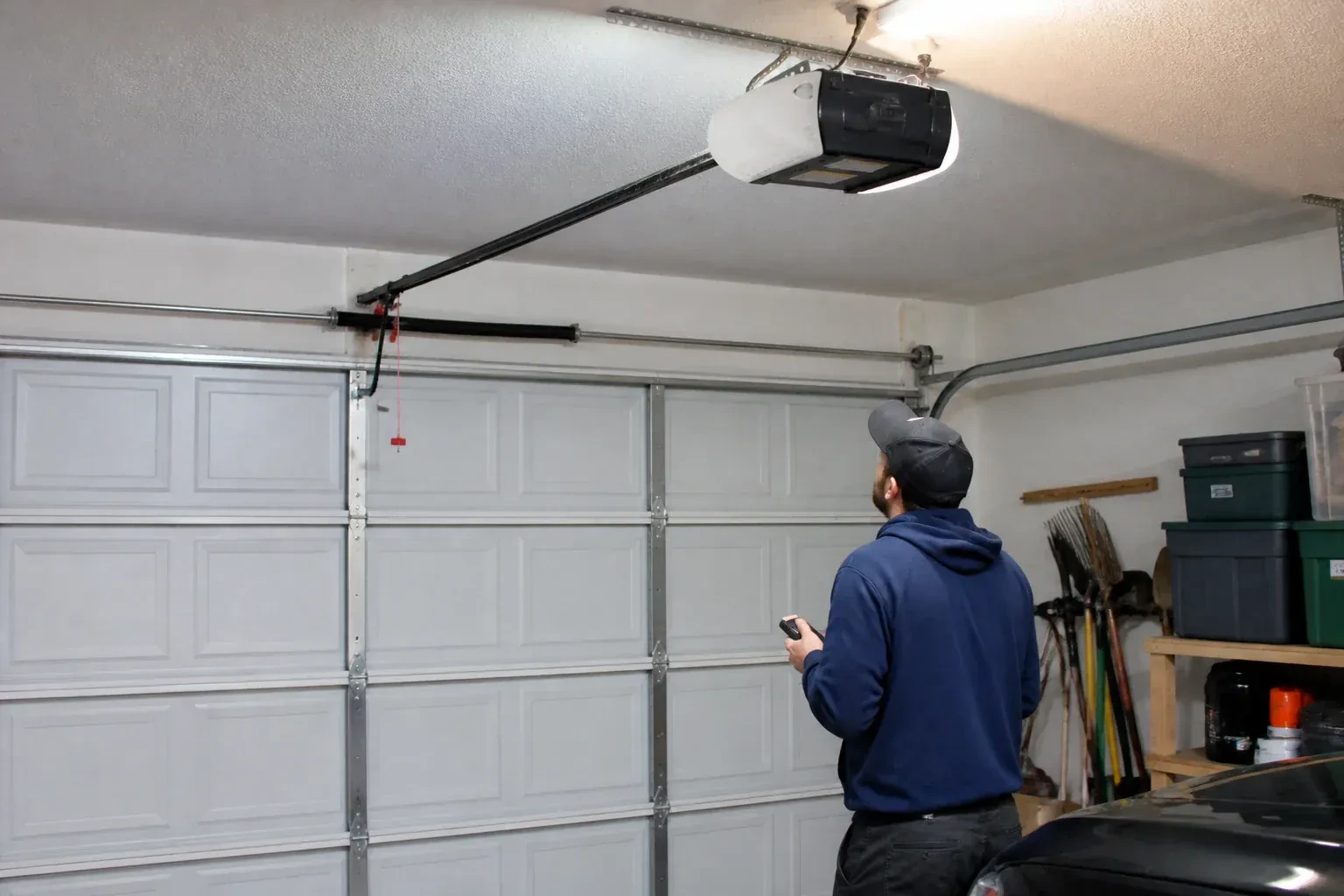
For a few days there was a grinding sound whenever the door started moving. Now the motor spins freely and the door stays exactly where it is.
Garage Door Opener Diagnosis and Repair
In plain words
What you get from the visit is more than a working door. You get told, in plain words, what was wrong and why it happened: a gear that had run dry for years, a sensor knocked out of line by a snow shovel, a wall control left in lock mode by a visiting grandchild. Small repairs are done on the spot, settings are recorded, and the door is demonstrated on every control you own. You also learn the short monthly test that catches most opener problems before they strand a car, so the next fault is one you notice while it is still small.
How the visit goesYou press the remote from the driveway and hear the motor hum overhead, a steady drone with no movement behind it. The door stays shut. Press again and the hum returns, then quits, as if the machine is trying and cannot get a grip on anything.
Smithville
How the visit goes
Limits, force and the two safety tests
Finally the settings are checked against what the door actually does. Travel limits decide where the door stops at the top and how firmly it meets the floor; a limit set slightly long makes the door hit the slab, sense an obstruction and pop back open. Force settings decide how much resistance the opener tolerates before reversing, and these drift, or get turned up to hide a stiff door. Both are read, the door is run through full cycles, and the contact reversal test with a 2x4 and the beam-interruption test are performed. Any setting that only passes because force is cranked high is treated as a symptom.
Controls, remotes and programming
Control faults are corrected at the control that failed. A wall console in lock mode is released by holding its lock button until the indicator stops flashing. Remotes get fresh batteries of the type the maker specifies, then are reprogrammed to the head unit with its learn button if the memory was cleared. Range problems are traced to interference, most often from certain LED bulbs in the opener's own sockets, and cured by swapping bulbs or extending the antenna wire. A wall control with a shorted or pinched cable gets new low-voltage wire; a failed receiver or wall control is replaced with one compatible with the opener's frequency and coding.
Knowing the red handle
The red cord hanging from the rail is the emergency release, and you now know how to use it properly. Pull it only when the door is closed, so a door that turns out to be unbalanced has nowhere to fall. The door then lifts by hand, useful during an outage. To reconnect, most units re-latch when the opener is run and the trolley meets the carriage, or when the door is lifted until it clicks. The handle should hang no higher than about 1.8 metres and clear of the car. If the door feels heavy when released, that is a spring message, not a test of strength.
Garage Door Opener Diagnosis and Repair
In the van
- Bell wire and clips
- Drive gear and sprocket kit
- Transformer and board fuse
- Start capacitor
- Remote batteries (coin and cylinder cells)
What affects the quote
Same fees day, night or weekend
1Ceiling height and access
A standard-height garage puts the head unit in easy ladder reach. High ceilings, high-lift tracks, storage lofts or a car that cannot be moved add setup time and sometimes a taller ladder.
2Battery backup pack
DC openers with backup power carry a battery that ages like any other. If it is at the end of its life, its replacement is listed separately from the diagnosis.
3Getting in when the door is stuck shut
A garage with no side door and no house connection means working the release from outside before any test can begin, and the quote includes that entry step.
Garage Door Opener Diagnosis and Repair: questions
Why will the door close only while I hold the wall button?
That is a built-in behaviour, not a new fault. When the sensor circuit reports a problem, most openers refuse to close from a remote but allow a constant-pressure close from the wall control, because someone standing there can see the doorway. It is a strong signal that the photo eyes or their wiring need attention, and once the sensor issue is corrected the door closes normally from every control again.
There are white plastic shavings under the opener. What are they?
Teeth from the drive gear. Many chain-drive openers use a nylon gear between the motor and the sprocket, and after years of running, especially against a heavy or dry door, its teeth shear off and fall as fine white curls onto whatever is parked below. The motor then spins without moving the chain. The gear and sprocket are replaced as a kit, and the door balance is checked so the new gear is not asked to carry the same load.
My opener went completely dead after a power outage. Is it finished?
Not usually. Outages and the surges that ride along with them commonly trip a breaker or a ground-fault receptacle, blow the small fuse on the board, or knock out the transformer, and each of those is a modest repair. A surge that damages the logic board itself is the more serious case, and whether that board is replaced or the unit retired depends on the model's age and part availability. The diagnosis tells you which case you have.
Openers & Access
- Belt-Drive Opener RepairHalfway up, every single time, the door hesitates and there is a ratcheting sound from the motor…
- Garage Door Opener ReplacementThe opener in the ceiling is older than the car parked under it.
- Photo-Eye Sensor Alignment or ReplacementAfter a cold night the door stays open until the garage warms up.
Garage Door Opener Diagnosis and Repair near you
Homeowners in Smithville can read below about the repairs we make most, the parts we replace, the opener and remote work we do, and how a new door is chosen and installed. Commercial customers will find rolling and sectional door service alongside the residential pages.